The zebra is dancing
The Art of Racing in the RainThe zebra is dancing names both a terrifying episode in Enzo’s isolation and a recurring image for the fear and destructive impulses that intrude on the family’s worst moments. At first Enzo treats the zebra as an external, supernatural threat; later, he recognizes it as something within people themselves. The expression’s force lies in that shift, while the uncertainty surrounding its first appearance reflects the limits of Enzo’s knowledge and his tendency to turn distress into a vivid story.
First Appearance in Zoë’s Room
During an absence that leaves Enzo alone for days, he rations toilet water and searches for food. Roughly forty hours into his solitude, after licking old yogurt from the legs of Zoë’s high chair, he hears a sound from her bedroom. He thinks he may be hallucinating, but sees the stuffed zebra there—the toy sent by Denny’s parents and one of Zoë’s favorites. Enzo has long regarded it as a rival for her affection, and is surprised it was left behind when Eve took Zoë away.
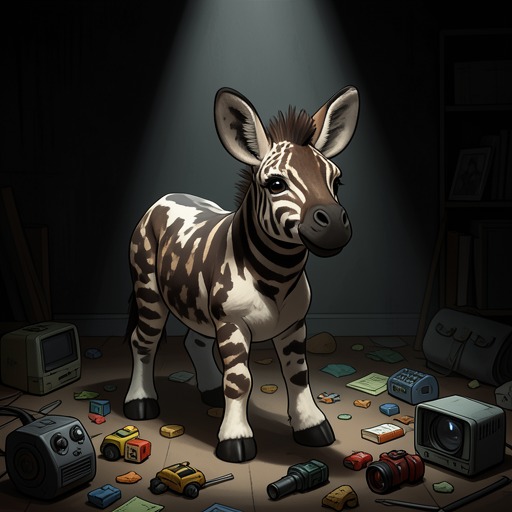
In Enzo’s account, the toy begins to move and dances among Zoë’s toys. He grows angry as it mistreats them, then moves to confront it. Before he can reach it, the zebra stops, tears open its own seam, and removes its stuffing until only fabric and stuffing remain. The episode leaves Enzo traumatized. He hopes it was a vision caused by hunger, yet remains convinced that something terrible happened. The story preserves both explanations: a dog under physical strain may have imagined the scene, but Enzo’s narration presents the zebra’s apparent life as an experience he cannot dismiss.
The House After the Vision
When Denny returns, Enzo stays away from Zoë’s room, unwilling to encounter the zebra again. Later, Denny finds the room in disarray, with Zoë’s dolls and animals torn apart. Enzo assumes the zebra must have reassembled itself and destroyed them after he left. Denny instead blames Enzo, drags him into the room, and strikes him; Eve intervenes and shields him. The consequences make Enzo’s interpretation more than an eerie private vision: his belief that the zebra is responsible shapes his understanding of the destruction, while Denny’s anger turns the unexplained mess into a family crisis.
That account also demonstrates why Enzo’s narration cannot simply be treated as an objective explanation of events. He reports what he sees and feels, but his conclusion about the toys rests on an assumption. His conviction that the zebra acted does not establish that it did. The gap between observation and explanation is central to the image: the zebra becomes a name for what is frightening and difficult to understand, even when Enzo cannot verify its cause.
A Recurring Image of Fear
The zebra returns as Eve’s health declines. Enzo has already detected an unusual odor near her head, which he interprets as evidence of disease, but has no way to warn her. As Eve’s pain and distress grow, he stays beside her, and she describes the frightening presence she feels when she is alone with her pain. Enzo associates that fear with the zebra, thinking that it hides everywhere. The image links the toy episode to a different kind of threat: not a figure Enzo can confront in a bedroom, but suffering that he can sense and cannot remove.
The image also appears amid ordinary family conflict. When Denny and Eve are tense about his racing absences, Enzo describes detecting their anxiety through bodily signals. After Eve apologizes for becoming unlike herself, Zoë holds her mother and Denny joins them. Enzo interprets the family’s embrace as a resolution, but the warning that the zebra hides everywhere complicates that apparent calm. The expression suggests that distress can persist beneath moments of reconciliation; it is not confined to the room where the toy first seemed to move.
Recognition and Narrative Meaning
The clearest reinterpretation comes through a souvenir pen from Woodland Park Zoo. Its small plastic scene contains a zebra that slides across a savannah when the pen is tipped. Seeing it, Enzo realizes that the zebra is not simply something outside the family: it represents fear and people’s self-destructive nature when they face their worst times. The toy’s menace is recast as an inward possibility, not a separate demon that can be defeated by attacking it.
That recognition reframes the earlier episodes without erasing their uncertainty. Enzo may have hallucinated the dancing toy while hungry; he may also have mistaken his own assumptions for an explanation of the destroyed toys. Later, his encounter with the pen gives the recurring image a psychological meaning, but does not make his earlier account reliable in every detail. The expression therefore marks both an interpretive change and a limit: Enzo can arrive at insight, yet his canine perspective, emotional loyalties, and incomplete access to events shape the path by which he reaches it.
Recurrence Under Pressure
The zebra remains associated with moments when grief or fear overwhelms ordinary restraint. When Enzo runs away in distress, he encounters a squirrel and acts on an intensity he has not previously recognized in himself. He describes the episode as a return to being an animal, an attempt to escape the pain he cannot bear as a humanlike observer. This does not make the squirrel episode another literal appearance of the zebra; rather, it echoes the later insight that destructive impulses can emerge from within.
The expression’s progression—from a moving stuffed toy, to a danger Enzo believes is loose in the house, to an inward figure for fear—gives it a structural role in the narrative. Each recurrence tests the difference between what Enzo senses, what he infers, and what he later understands. The zebra is frightening partly because it seems to act beyond explanation, and partly because its eventual meaning denies the comfort of blaming every destructive force on something external.